
10,000 pixel miners · Robinhood 4663
click anywhere to skip
 ROBINHOOD 4663
Every miner is drawn cell by cell on a 48×60 grid — no generator prompts, no smoothing, no upscaling tricks. Plan one blast, clear four diamonds without dropping a beam, and your first miner is free. After that they cost 0.0001 ETH each, up to 25 per wallet.
Nothing here is hidden. Four diamonds to bring out, six support beams that have to survive, and gold seams that carry a blast from one cell into the next. You get two charges and one detonation — so the biggest chain is usually the wrong one. Land it clean and the free claim unlocks. Buying doesn't need any of this.
Every face is checked before you see it, so a solution always exists — if it goes wrong, the plan was wrong, not the board. What the blast can't do is stop a second free mint: the contract does that, by address, and no browser can talk it out of it.
One free miner per wallet, then 0.0001 ETH each. Twenty-five per wallet is the lifetime cap and the free one counts toward it.
One per wallet, enforced on-chain by address. Land a clean blast above to reveal the claim. Free miners are drawn from the Common and Uncommon pool — a good miner, not a rare one.
Buy straight away — connect, pick an amount, mint. Paid miners are the only way into Rare, Epic and Legendary: every one of the 1,000 rare-tier miners sits in this pool. Roughly half of paid mints land Rare or better. Up to 25 total per wallet on Robinhood Chain 4663.
Contract address publishes at launch
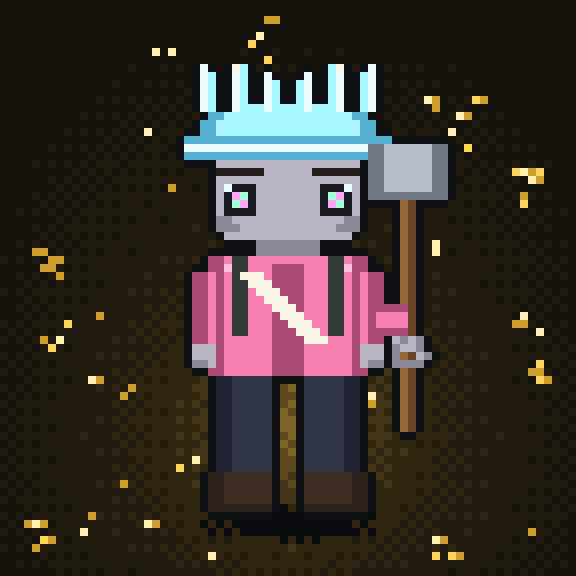
Every tier is a visible difference, not a label. Gold helmets exist only at Epic; the diamond crown, prismatic eyes and the diamond vein wall exist only at Legendary. Counts below are read straight from the shipped metadata.
Odds are computed from the tier supply in the metadata, not chosen for the pitch. Which token id you receive is drawn on-chain at mint — the pool decides what is possible, never the order.
Ninety-six real tokens from the shipped art, weighted toward the rare tiers on purpose so you can see what the paid pool holds. This is not the collection's true mix — 70% of all 10,000 are Common. Every cell is badged with its real tier.
Real counts from the collection metadata, not estimates. All eight axes, all values, nothing sitting at zero.
It controls what this page offers you, and nothing more. Any browser
game can be bypassed by calling the contract directly, so it would be
dishonest to tell you the blast is the gate. The real limit is
claimedFree(address) in the contract: one free miner per
address, checked on-chain, no exceptions. The blast is how you earn it
here — the contract is what enforces it everywhere.
Twenty-five in total, for the life of the collection. Your free miner counts as one of those twenty-five, so a wallet that claims the free one can buy twenty-four more at 0.0001 ETH each.
The first is free once you have landed a clean blast. Every one after that is 0.0001 ETH on Robinhood Chain 4663. The price is written into the contract at deploy and cannot be changed afterwards.
No. Paid mints skip the rock face entirely — connect a wallet, pick an amount, mint. The blast exists only to earn the free miner. If you would rather just buy, nothing on this page asks you to play first.
Those are seams, and they are the whole puzzle. A charge breaks its own cell plus the four touching it — but anything broken then travels along every seam it touches, and keeps travelling, so one charge on a long seam run can take out a third of the face. That is why the biggest chain is usually the wrong one: six support beams have to survive, and a blast that reaches further than you planned brings the roof down. Watch cells in blast in the readout as you move a charge — it counts exactly what the detonation will take, before you commit.
No. Before a face is shown to you, every one of the 1,128 possible two-charge placements is checked and the face is discarded unless at least one of them clears all four diamonds with all six beams intact. So a solution always exists. If a blast goes wrong it was the plan, never the board — and a fresh face costs nothing.
No. Each miner is composed from hand-authored pixel cells on a 48×60 logical grid, mirrored for exact front symmetry and scaled up with nearest-neighbour only — 72 cells at exactly 8 pixels each, so the grid stays even. There is no diffusion model and no smoothing anywhere in the pipeline.
Not yet. The contract is not deployed, so the mint button stays disabled and no address is published on this page. When it goes live the address appears in the Claim section above and the button switches on. Anything claiming to be the Miners Hood contract before then is not ours.
Every miner carries a Tier trait, and the tier is a real
pool with a hard count: 7,000 Common, 2,000 Uncommon, 700 Rare, 250 Epic,
50 Legendary. Tier is not a label bolted onto identical art — each
grade owns traits that do not exist below it. Gold helmets and plasma
drills start at Epic; the diamond crown, prismatic eyes and diamond vein
wall are Legendary only. Every combination is still unique.
Yes, and it is the only thing that does. All 1,000 Rare, Epic and Legendary miners sit in the 2,000-token paid pool, so a paid mint has about a 50% shot at Rare or better. The 8,000 free miners are drawn from Common and Uncommon only — digging earns you a miner, it cannot earn you a grail. That is the trade: the free one costs attention, the rare ones cost 0.0001 ETH.
No. You choose the pool by paying; the chain chooses the token. Letting buyers hand-pick a Legendary would make the count meaningless, and any page that promises a specific rare token before mint is lying about how minting works.